
On This Page

Welcome to Marathon


Alaine and Noble's papercrete building blog

Read the whole blog


Holistic B&B in remote Marathon deserves a return visit

By Camille Flores
Assistant Features Editor
San Antonio Express-News
October 10, 2004

MARATHON — The first time I visited Eve’s Garden Organic Bed & Breakfast in Marathon, I was looking for a healthful meal. The drive between El Paso and San Antonio on U.S. 90 is surreally beautiful, lonesome for the most part, and devoid of vegetarian restaurants. I had spotted an ad for Eve’s in a regional magazine and determined to find it on the off chance it served lunch as well as breakfast.

Continue Reading Holistic B&B in remote Marathon deserves a return visit


The Not-So-Secret Garden

By Marlys Hersey
The Big Bend Gazette, May 2004

MARATHON — I feel like Alice in Wonderland. Or Charlie in Willy Wonka’s Chocolate Factory. I’m clearly in a magical place, however there is no sinister rabbit coaxing me on, no enigmatic, snappish Willy Wonka leading me further into his factory and testing to see if I’m worthy of learning his secrets of the trade.

Continue Reading The Not-So-Secret Garden


About Eve’s Garden

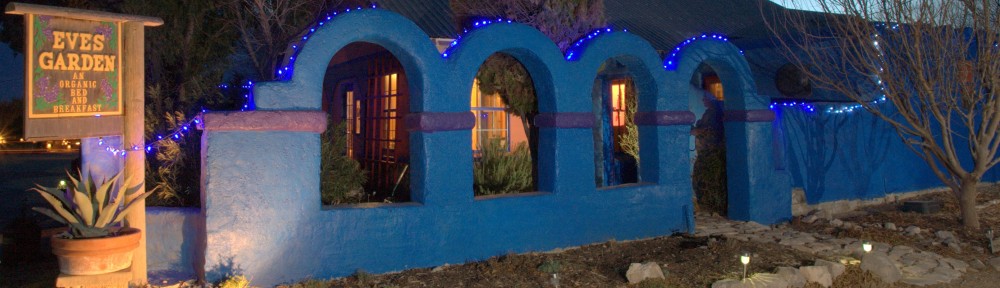
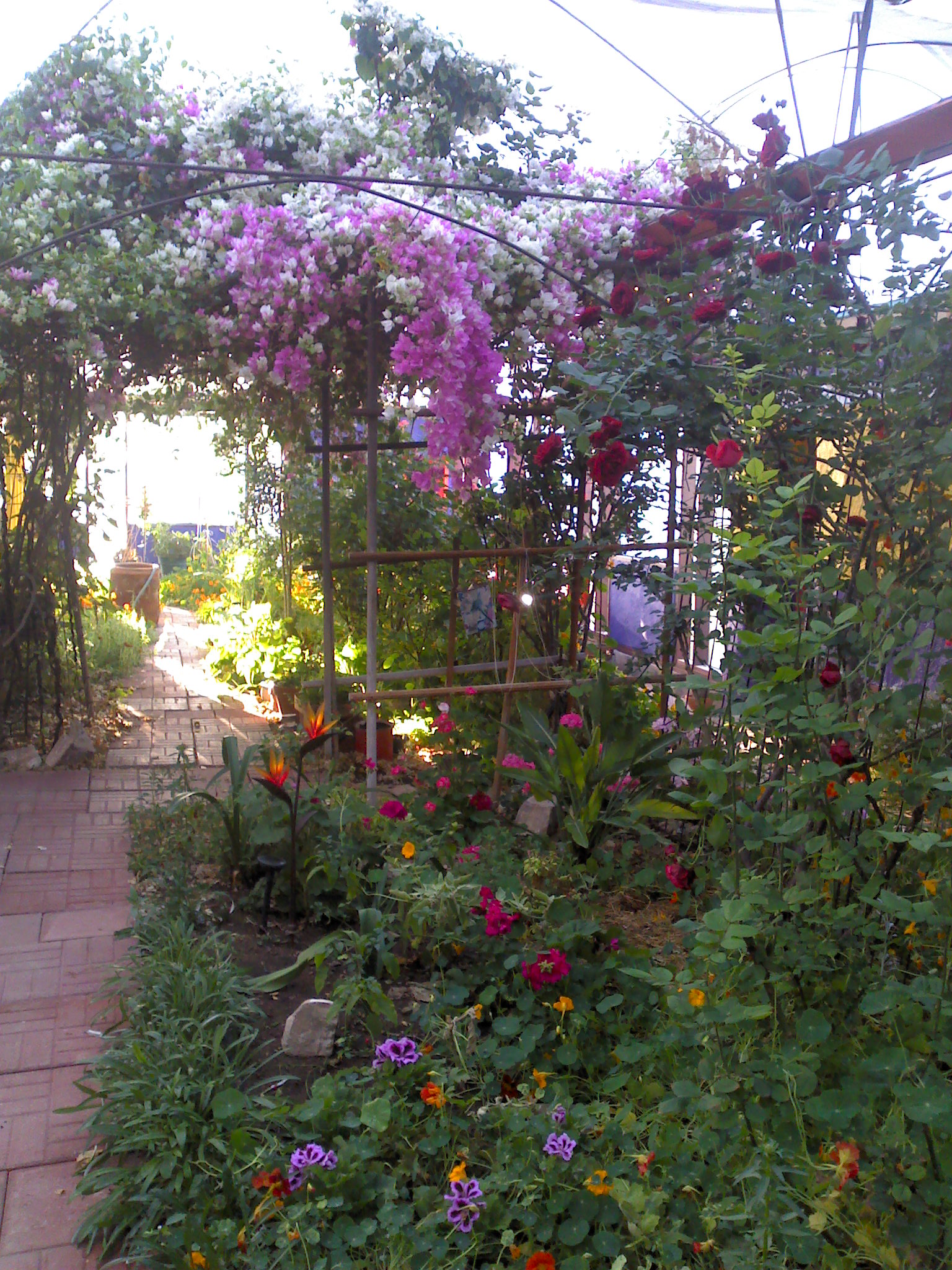
Eve’s Garden is an organic Bed and Breakfast and Ecology Resource Center, located in the beautiful high mountain desert of West Texas, at the gateway to Big Bend National Park, in Marathon, Texas. Eve’s Garden is a research level organic gardening demonstration site and an urban hacienda, combining to provide a comfortable Bed and Breakfast environment and a conversational forum to address issues regarding the ecology we live in.

Every effort has been made to combine elements of “art”, “architecture”, and “ecology” in the layout and construction of this unusually progressive piece of work. A large amount of recycled content, strawbale buildings, paper adobe/fiber cement buildings, high Mexican contemporary color treatments, and a focus on locally produced food, conspire to create an aura of thoughtfulness.

“Thoughtfulness” — this is our goal — to motivate our guests to pursue the projects they have in their minds, and recognize that they can make a difference.

We, Clyde T. Curry and Kate Thayer, invite you to come and share your vision for the future and to see our work. Enjoy a stay at our Bed and Breakfast, join the FORUM on our website, and survey our environmental links.

We invite you to get involved, because “we” are the “they” in “they need to do something”.


Environmental Links

Other West Texas Resources

A Vision for a New Civilization

If we are to create a Paradise on Earth we will have to change the way we live with ourselves.

In developed countries, the high cost of living requires that we earn lots of money. If we work hard and earn a lot, then something must be produced with that effort. If goods are produced, they must be consumed or else we will have no work. If they are consumed, natural resources must be used. If natural resources are used excessively and not recycled, as they presently are, then the earth is wasted. Therefore a high standard of living, based upon mass consumption and minimal recycling (our present design) inevitably leads to the destruction of the ecosystems that we rely upon for our survival. If undeveloped countries follow our path, the destruction of the ecosystems we depend upon is assured.

If we can eliminate the high cost of living, then we can live more sensibly on the Earth. In the past, a simpler lifestyle meant a low quality of life, but does it really have to be?

read more at planetaryrenewal.org

News Forum

Is a Food Revolution Now in Season?

By Andrew Martin
The New York Times
March 22, 2009
Anaheim, California — AS tens of thousands of people recently strolled among booths of the nation’s largest organic and natural foods show here, munching on fair-trade chocolate and sipping organic wine, a few dozen pioneers of the industry sneaked off to an out-of-the-way conference room.

Although unit sales of organic food have leveled off and even declined lately, versus a year earlier, the mood among those crowded into the conference room was upbeat as they awaited a private screening of a documentary called “Food Inc.” — a withering critique of agribusiness and industrially produced food.

They also gathered to relish their changing political fortunes, courtesy of the Obama administration.

“This has never been just about business,” said Gary Hirshberg, chief executive of Stonyfield Farm, the maker of organic yogurt. “We are here to change the world. We dreamt for decades of having this moment.”

Continue Reading Is a Food Revolution Now in Season?

Posted by Paul on March 26, 2009

It’s Organic, but Does That Mean It’s Safer?

Kim Severson and Andrew Martin
The New York Times
March 4, 2009

MOST of the chicken, fruit and vegetables in Ellen Devlin-Sample’s kitchen are organic. She thinks those foods taste better than their conventional counterparts. And she hopes they are healthier for her children.

Lately, though, she is not so sure.

The national outbreak of salmonella in products with peanuts has been particularly unsettling for shoppers like her who think organic food is safer.

The plants in Texas and Georgia that were sending out contaminated peanut butter and ground peanut products had something else besides rodent infestation, mold and bird droppings. They also had federal organic certification.

“Why is organic peanut butter better than Jif?” said Ms. Devlin-Sample, a nurse practitioner from Pelham, N.Y. “I have no idea. If we’re getting salmonella from peanut butter, all bets are off.”


Continue Reading It’s Organic, but Does That Mean It’s Safer?

Posted by Paul on March 04, 2009

Mr. Whipple Left It Out: Soft Is Rough on Forests

By Leslie Kaufman
The New York Times
February 26, 2009

Americans like their toilet tissue soft: exotic confections that are silken, thick and hot-air-fluffed.

The national obsession with soft paper has driven the growth of brands like Cottonelle Ultra, Quilted Northern Ultra and Charmin Ultra — which in 2008 alone increased its sales by 40 percent in some markets, according to Information Resources, Inc., a marketing research firm.

But fluffiness comes at a price: millions of trees harvested in North America and in Latin American countries, including some percentage of trees from rare old-growth forests in Canada. Although toilet tissue can be made at similar cost from recycled material, it is the fiber taken from standing trees that help give it that plush feel, and most large manufacturers rely on them.

Continue Reading Mr. Whipple Left It Out: Soft Is Rough on Forests

Posted by Paul on February 26, 2009

Could ‘liquid wood’ replace plastic?

By Brian Whitley
Contributor to The Christian Science Monitor
February 11, 2009 edition
Almost 40 years ago, American scientists took their first steps in a quest to break the world’s dependence on plastics.

But in those four decades, plastic products have become so cheap and durable that not even the forces of nature seem able to stop them. A soupy expanse of plastic waste – too tough for bacteria to break down – now covers an estimated 1 million square miles of the Pacific Ocean.

Continue Reading Could ‘liquid wood’ replace plastic?

Posted by Paul on February 16, 2009

Palm oil frenzy threatens to wipe out orangutans

By Robin McDowell
The Associated Press
January 18th, 2009

TANJUNG PUTING NATIONAL PARK, Indonesia (AP) — Hoping to unravel the mysteries of human origin, anthropologist Louis Leakey sent three young women to Africa and Asia to study our closest relatives: It was chimpanzees for Jane Goodall, mountain gorillas for Dian Fossey and the elusive, solitary orangutans for Birute Mary Galdikas.

Nearly four decades later, 62-year-old Galdikas, the least famous of his “angels,” is the only one still at it. And the red apes she studies in Indonesia are on the verge of extinction because forests are being clear-cut and burned to make way for lucrative palm oil plantations.

Continue Reading Palm oil frenzy threatens to wipe out orangutans

Posted by Paul on January 20, 2009